Thursday, March 14, 2019
Command and Colors board - getting there...
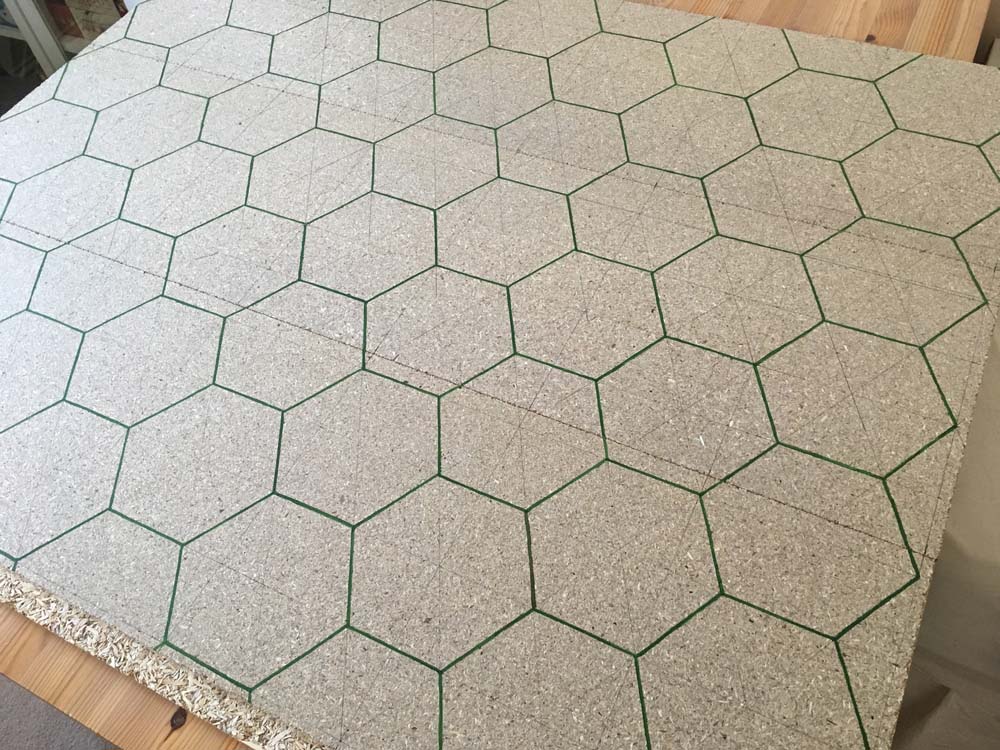
Having painted in the hex lines using white paint, the next step was to go over them using a dark green. So far, I've done this for four of the six required boards. You can see three pictured here, slotted together.
Once this was done, it was time to add the flock. I'm using Noch flock, which is the same stuff I use on the bases of my figures. I used a slightly watered down PVA as the glue, and then used a sieve to apply the flock, which helped to ensure the application was even. I don't want the finished surface to be too uneven, since there will be MDF terrain hexes sitting on top.
And here's a shot of the first finished board. It's ok, but I've learned a few things about how I'd do it differently next time. My biggest mistake was using a fine pen to mark out the lines needed to plot the hexes. I had assumed these wouldn't be visible underneath the flock, but I was wrong! I'll make sure I use a pencil next time.
I think a bit of colour variation would improve the look, so if I do this C&C board again, I'll paint a thin coat of browns and green over the hexes before applying the flock. This will also help to mute the hex lines a bit.
This weekend I'm hoping to get most of the other 5 boards finished. After that, I'll be thinking about putting together the terrain hexes for hills and rivers etc. For buildings, I've ordered a 10mm scale black powder set from Total Battle Miniatures, so I'm looking forward to those arriving and getting them painted up.
Meanwhile, figure painting progresses steadily. I added more bases to the Prussian infantry this week, and have another base of horse artillery currently on the paint bench. More photo updates soon!
Tuesday, March 5, 2019
Commands and Colors board - a bit more done
It's been a bit of a slow week or two for the hobby. Too much work, not enough leisure time. A familiar story for many. I have, however, found time to progress the Commands and Colors hex board.
I started marking out the hex grid on the first three sections of chipboard, which are now almost finished. I'll need six of these for a standard size 13 x 9 hex C&C map, so I'm about half way there with this part of the project.
It didn't take too long, once I got into a rhythm. It's not a terribly exciting task this - but strangely therapeutic at the same time.
I'm using white acrylic paint to begin with, but at this stage I'm undecided about whether I should leave the lines at that, or colour them some sort of green or brown shade. I'll probably do the latter, which is more work of course, but I think it'll look better (and less conspicuous) once the hexes are flocked.
As far as figure painting goes, I'm continuing to add extra bases to most of the units in both the French and Prussian collections. This past fortnight it's been mostly cavalry, and now I'm adding bases to boost the Prussian infantry. I did take some quick photos with my phone, but the light was awful, so not much point in sharing them. I'll add a few photos to the next blog post when I get a chance to photograph them properly.
Hope to show you a couple of finished sections of the board soon.
Wednesday, February 20, 2019
Some more French
I knocked out a couple more bases of French line infantry this week. I'm picking my way through the lead pile at the moment, painting up what I have left before I order some reinforcements from Newline Designs.
With these two bases done, it means I now have a total of 5 line infantry units at 36 figures per unit. I'll be adding more units as soon as I can, probably to take me up to 8 in total. It's doubtful I'll have enough units to match the contents of the Prussian expansion set for Commands and Colors any time soon, so once I have my board and the terrain ready I'll probably just be playing scenarios of my own design using what I have available.
Alongside this, I need to add light infantry and cavalry. I'm adding stands here and there at the moment, bringing each unit up to the number of figures I need for each (12 figs for cav).
These three chaps are next in line for painting. It'll take my chasseurs a cheval unit from 9 to 12 figures, and I'll be doing the same for the line lancers. Lots more cavalry will be needed though.
In case you're wondering, I don't use Golden Acrylic paints on my figures - these are just old pots that are very handy for attaching the figures to for painting. They're a comfortable fit in my hand, and hold the blu-tack well.
Meanwhile, I'm still deliberating my choice of surface for the hex board. More on that in my next post.
Sunday, February 17, 2019
The 6-inch hex and its metric cousin
Having settled on 6-inch hexes as the best compromise between hex size and table size, I ended up shrinking this ever so slightly. I'll explain.
My new gaming area is going to be a spare room in the house which is big enough to accommodate an 8 x 4 foot table reasonably comfortably. I will be able to walk round both ends of the table and also have a decent amount of space along each side. As a maximum, I could extend this to 10 x 5, but for now I'm aiming for 8 x 4 as my ideal size.
I'm planning to use chipboard loft panels as my gaming surface. They measure 4 feet long by a little over 1 foot wide, and are tongued and grooved so they'll fit together fairly snugly. The room is used for other activities besides gaming, so I need to be able to dismantle my table and store it away somewhere, hence my idea to use the loft panels (on top of fold-away tables or trestles, probably).
After some quick calculations, however, I realised that using 6-inch hexes would be slightly too big to fit a standard Commands and Colors 13 x 9 hex area onto a 4-foot wide table. The ninth hex on the short side would be cut-off slightly, and if I ever wanted to increase the depth to 11 hexes in order to play an epic battle, then I'd need more than 5 feet of width, which would be too tight for the room.
Anyway, the short story is I reduced the hex size from 6 inches to 150mm, which is only about 2mm smaller but means I can just fit 9 hexes inside a 4-foot wide board.
So, with that decided, I started drawing out the hex grid onto the panels today (a job still in progress), and also spent some time pondering how best to cover the surface. Should I use flock or should I keep it simple and just use paint? I wasn't - and I'm still not - entirely sure, so I did a quick experiment first of all with making a flocked hex on one of the board's undersides. I like the look of it, and the colour of the board underneath helps to break up the green a bit.
Another advantage is that the flock will match my figure bases quite closely, and it'll provide a bit of friction to keep terrain tiles in place. But, one drawback is that the surface won't be completely flat, so any terrain tiles might sit on top of the flock slightly unevenly. There's also the added time involved in flocking the whole board, and the fact that the flock does tend to shed fibres somewhat.
I'll need to ponder this some more before I decide. I might need to order some hexes first and see how well they sit on top of the flock.
Back in the real world, it was not a bad day at all here in Stirling, if a little fresh, so my better half and I headed out for a walk around Bannockburn, starting off in Cambusbarron and heading up to Gillies Hill before working our way down to Bannockburn and the visitors' centre. It's a nice way to spend an hour or two if you've never walked that way before, and a good way to approach the battlefield site.
![]() |
| The heritage trail at Gillies Hill. You're on the west side of the battlefield at this point. |
![]() |
| Crossing over the Bannock Burn. Still on the west side of the battlefield at this point, behind where Bruce's army would have been. |
Friday, February 15, 2019
Commands and colors and hexes
I've been giving more thought recently as to which set of rules I'd like to focus on for my Napoleonic games. To tell the truth, I've owned far more sets then I've ever played, or even got round to reading, and I often made snap purchases of this or that ruleset whilst building up my collection of minis last year. I was happy to browse the possibilities, always feeling sure that I'd settle on something eventually.
But I never really did, and not having a particular game in mind has, I think, allowed the project to lose a bit of steam.
Despite dabbling with various rulesets, popular or otherwise - and also (briefly) contemplating making my own rules cannibalised from all the bits I liked from other people's - there is really only one game that I have played consistently. As you can probably guess from the blog post title, that game is Commands and Colors.
I bought the Ancients version of C&C years ago and loved it so much I quickly acquired the Napoleonic version, which I also throughly enjoyed. I added several of the expansions and, for a while, was more than content to play the game out of the box using the pretty blocks and the terrain tiles.
Like many other gamers, however, I soon desired to convert the experience into one involving miniatures rather than the wooden blocks. I did manage this a few times, but only in a limited fashion. My relatively small figure collections meant that units were only thinly represented and the overall effect wasn't the superior experience to boardgame I hoped for.
Besides my 20mm French and Prussian armies, I have a some Austrians and French in 10mm, and experimented with both of these scales using Hexon terrain tiles from Kallistra.
For my own tastes, the 20mm figures are only a modestly good fit for Kallistra's 4-inch hexes. A comfortable number would be about 12 figures I reckon, which might satisfy some folk, but it doesn't really give the density of troops I'm looking for.
24 figures is better, but at this point things get awkward with regards to leaving space for trees and buildings.
The issue of space is as much a problem for 20mm cavalry figures. It just feels a bit cramped.
My 10mm mins on the other hand are much better suited to the 4-inch tiles, which is no great surprise since Hexon tiles go hand in hand with Kallistra's own 12mm figure ranges. If I wanted to do Commands and Colors using 10mm minis - and I do plan on doing this one day - then these 4-inch hexes will be my product of choice. But, at the moment my preference is for something a bit bigger.
So, back to the 20mm figures and I started experimenting with other sizes of hex, including 5, 6 an 7 inches. 5-inch hexes are an improvement (obviously), but still don't quite deliver the overall look I'm aiming for. 7 inches is luxurious and roomy - a bit like a super king size bed - but the resulting table size would be an issue for this house (as would a super king size bed, sadly). In the end, a 6-inch hex seemed like the best compromise all round.
I found that using this size will allow me to field a decent mass of troops on each hex, whether infantry or cavalry, whilst still leaving a reasonable amount of space for terrain. Crucially, the existing base sizes in my collection are well suited to it, so I won't need to consider any rebasing terribleness. For infantry, it will mean 36-figure units; for cavalry, I'm looking 12 figures in a unit. Light infantry will be something similar to line but with a few open order bases mixed in, while artillery units will probably consist of two bases. Leaders will be based separately as the game requires.
Being the tidy sort, I rather like my unit frontages to be roughly the same, and again this works out quite well. Infantry units are 105mm across, while cavalry is not far off this at 90mm.
The only problem with all this lovely massing of figures is the fact that I will need rather a lot more of them! But, Rome was built in a day as they say, and neither are most miniatures collections.
Rather than let this post ramble on too long, I'll sign off now and return in a day or two to share my thoughts on the many other details of this project and what I'll be doing next for it. Elsewhere, the modular terrain tiles I showed in previous posts will still be getting worked on occasionally, but might not see any meaningful battle action until some point further in the future.
In the meantime, I'm rather excited to be releasing the pause button on getting on with the 20mm Napoleonics again. Huzzah!
Saturday, January 26, 2019
Terrain tiles - making progress
![]() |
| The full set-up so far: 3x4' (12 tiles) |
![]() |
| The roads are a mix of sand and Javis earth scatters |
![]() |
| The Prussian commanders eye the French on the opposite hill |
![]() |
| A few tiles warped slightly, creating a bigger gap when joined together. Nothing that can't be easily fixed or dressed up a bit before play |
For the most part, the boards magnetise together very neatly, but there are a few which ended up becoming very slightly warped during the build. This was my own fault, having got a bit carried away with too much glue, paint, filler etc. I've learned that, with a bit of care, the mdf frames should not normally bend along their sides, so I should be able to avoid this in the future.
![]() |
| The tile normally click together very neatly |
For the ground cover I used a combination of foam flock, various scatters and a little bit of static grass. It's all sealed with scenic cement, so it shouldn't shed too much.
![]() |
| Pond / lake feature using Woodland Scenics resin |
Once I finish the four stream tiles, the plan is to expand the board to cover a 6x4' area, and eventually 8x4'. I love the modularity of the set up, and the fact that it breaks down and stores easily on nearby shelves. For games, I'll be able to use some gridded map paper to plan out the battlefields, which will be a bit of fun in itself. So, at last it feels like I have the beginnings of a gaming board which should serve me well for a long time to come.
Saturday, January 12, 2019
From one empire to another
![]() |
| Kurt Helborg - rescued from a 20-year stint in the lead pile |
With a new year on the horizon and my 20mm Napoleonic armies mostly done for the time being, I inevitably started thinking about possible new projects for 2019. My 20mm Napoleonics will be added to this year certainly, and I hope to enjoy many games with them, but for my main painting focus I would like to shift to something different. The question is, what?
My miniatures collection has a number of unfinished projects, and I mulled over each of these in turn, trying to decide whether I had enough enthusiasm to move any of them forward. In no particular order, I have (in various stages of progress):
- 28mm ancient greeks and spartans
- 28mm El Cid armies (a mixture of Spanish, Andulusians and Berbers)
- 20mm Napoleonic British
- 10mm Napoleonic French and Austrians (yes, more Napoleonics!)
- 10mm Seven Years War Prussians and Russians
- 15mm crusader and muslim armies
- 28mm WSS French (not really a collection; rather, a couple of units bought on a whim)
- 20mm Mahdist War
I couldn't (and still can't) really decide what to focus on first, so in the end I got all nostalgic and dug out something from my Warhammer Empire army: Kurt Helborg, Captain of the Reiksguard. This was one of only two unpainted miniatures from my collection from way back in 4th edition fantasy battle, and after 20 years or more languishing in the lead pile, I have finally rescued him with some paint.
![]() |
| Complete with Goblin Green base, naturally |
![]() |
| There was no such thing as being too colourful in 4th edition Warhammer fantasy |
![]() |
| I'm sure my fingers experienced a weird sort of muscle memory when they started painting another of those plastic barded warhorses |
Whatever I decide to do, I want to spend more time playing and a bit less time painting this year, and that means finishing off my terrain boards and getting my hobby space a bit better organised to facilitate some dice-rolling! The terrain boards are coming along nicely. I worked some more on them this month, so I'll post of some picture of those next. After that, some battle reports with the Napoleonics would be good. And after that? Who knows, but I'll have fun finding out.
Subscribe to:
Posts (Atom)